Stamped concrete services in Moses Lake WA - color you picked before the pour
Got a cracked or plain gray slab you're tired of? We pour new stamped concrete with the color and pattern you pick.
- Fully licensed and insured.
- Free estimates at your property.
- We reply within 1 business day.
What goes into a stamped concrete patio or walk in Moses Lake?
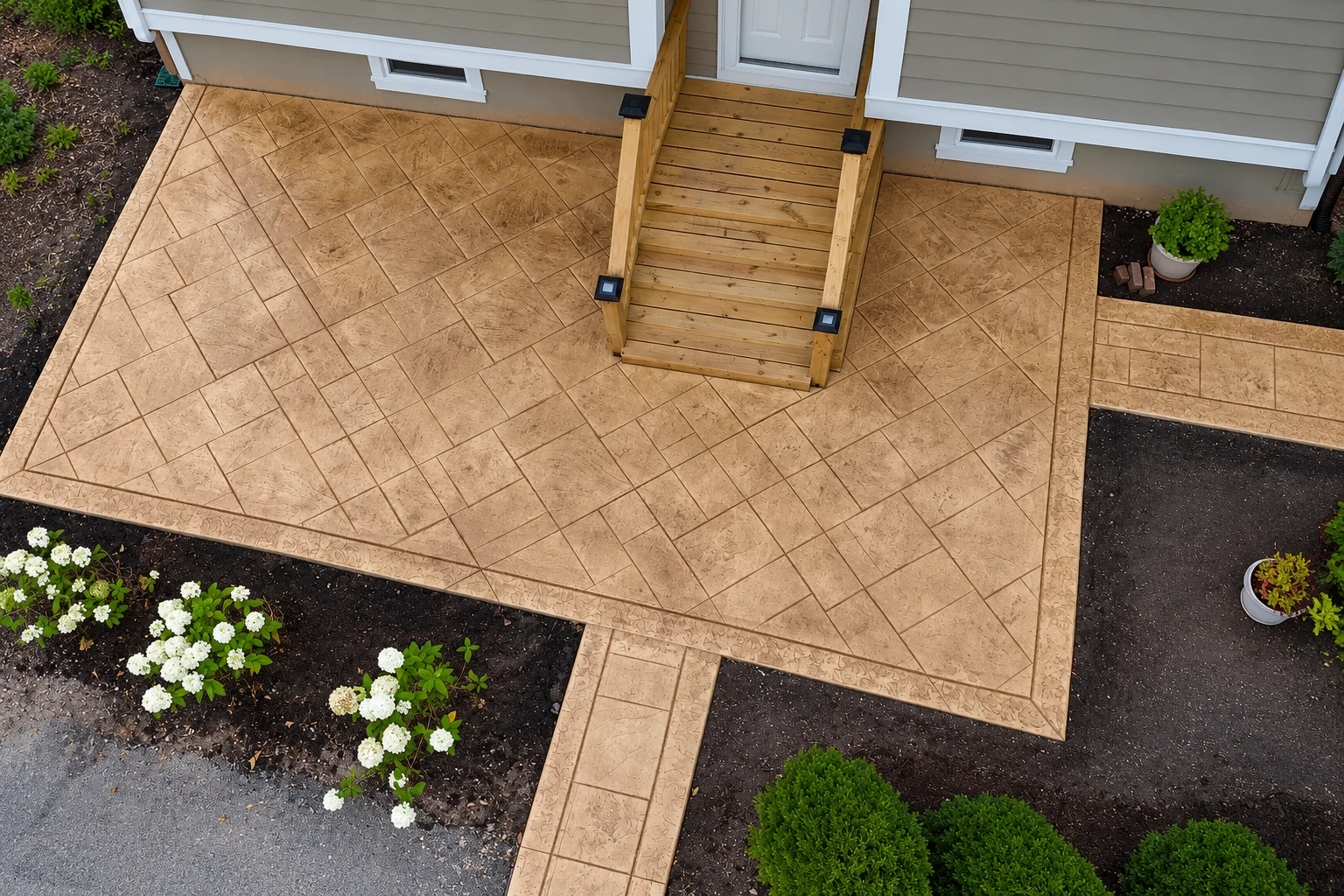
Stamped concrete services in Moses Lake start with a brand-new slab. We color it and press a pattern into the surface while it's still fresh, so your patio, walk or driveway looks like stone, brick or slate but stays one solid piece.
Most people who call me have a cracked or sinking slab they're done patching, or a plain gray concrete patio they'd like to look like more than a parking spot. The price moves with the size, the pattern, the color method and whether we're tearing out an old slab first. The schedule mostly turns on the weather, and on whether the work reaches the sidewalk or driveway approach, where the city has a say. You'll get your own number in the written estimate after I walk the job.
How do you know it's time for a stamped slab?
Cracks you keep patching
When the same cracks keep opening up and the pieces on either side sit at different heights, the ground under the slab has usually moved, and patching won't fix that. Waiting lets water work in underneath, so the tear-out gets bigger and the trip hazard gets worse.
Water pooling toward the house
Puddles that sit on the patio or run back toward your foundation usually mean the old slab settled or was poured sloping the wrong way. The longer it goes, the more water ends up against the house, and fixing that costs more than a new patio.
A plain slab you're tired of
Sometimes nothing's wrong but the look, and a bare gray slab out back is where a lot of people start thinking about stamped work. If the old slab is due for replacement anyway, that's the time to decide on color and pattern, because stamping only happens while the concrete is fresh.
How we do stamped concrete, from color to pattern
Color comes first on stamped work. Before anything else I explain the two ways to get it, color mixed all the way through the concrete or color worked into the top, and you pick the one that suits you. Then we dig out and pack the subgrade, the ground the slab sits on, because the concrete industry's guide calls for that ground to be packed even and dense and to be damp, with no standing water, when the concrete goes in. Nobody sees the base once the slab is down, so it's the first thing people want to cut from the budget. I'd rather spend the money there than on a fancier pattern, because a pretty slab on a soft base cracks just like a plain one. Once the base is ready, we pour, press the pattern while the surface is still workable and cut control joints. Those are planned grooves that give the slab a straight place to crack instead of wherever it likes. At the end we talk about sealing.
A lot of stamped jobs connect to other concrete. A stamped patio usually needs a path to the door, and our concrete sidewalk building work can match it or get a plain broom finish, the light dragged texture that gives your shoes some grip. If you're redoing the driveway, look at the slab inside the garage too, since cracked or sunken garage floor concrete is easier to replace while our crew is already there.
Color mixed all the way through
This suits most patios and walks, because the pigment goes into the fresh concrete and gives an even, streak-free color through the whole slab. If the surface ever chips, what's underneath is the same color, not plain gray.
Color worked into the top
This suits you if you want the color concentrated on the surface, since a dry-shake color hardener is spread over the freshly leveled concrete and worked in. The color lives in the top layer only, so I'll talk through where that matters on your slab.
Your stamped concrete estimate, in writing
Send the form and we'll reply within one business day to set up a visit. The estimate is free, done at your property and comes with no obligation, and afterward you get the scope in writing.
(509) 512-0637What Moses Lake changes about a stamped concrete job
In the backyard it's your property, but out front the city gets a say. Moses Lake requires its Street and Utility Construction Permit before any work in the public right-of-way. That covers streets, sidewalks, curb, gutter and driveway approaches, the strip where your driveway meets the street. The city also requires work on curb, gutter or streets to be done by a licensed and bonded contractor. Whether a stamped patio behind the house needs a permit is a question for the office that covers your address. Before I price the job, I check with the city or county office for your property. When a permit is needed, we handle the application or help you with yours, and we work to what that office decides.
Winter is the other thing. The city's design standards list a frost depth of at least 18 inches for Moses Lake, which tells you how deep the ground can freeze here, so we plan every outdoor slab for freeze and thaw and for the ice melt that ends up on it. We see the same winters on jobs in Ephrata and Othello, and from our base in Moses Lake we also work in Quincy and other cities around the area.
What happens after you call about stamped concrete in Moses Lake?
Call or send a message
Call or send the form, and we'll get back to you to set up a time for me to come out. We answer seven days a week, so evenings and weekends work too.
Walk the job with me
I walk the job with you, mark out the slab, go over color, pattern and the permit side, and then send a written estimate. You get the scope in writing, so you can see what the price covers and line it up against other bids.
Our crew preps and pours
Once you say go, our own crew preps the base, sets the forms and pours, and I'm on site to run the pour. The color and pattern go in while the concrete is fresh, and there's no redo once it sets, which is why I'm there for it.
Learn how to care for it
Before we leave, I show you how to care for the new concrete while it cures, which is the wait while it gains strength before it's ready to use. The first days after a pour matter as much as the pour, so ask anything then.
Frequently asked questions
How much does stamped concrete cost in Moses Lake?
Across the US, installing a stamped concrete patio usually costs about $24 to $29 per square foot. That's a national figure for patio work and not our price, and it shifts with the pattern, the color method and how much prep your ground needs. I'll price your slab on site and put it in writing.
Can I get my own permit for a sidewalk in front of my house in Moses Lake?
Yes. Residential owners in Moses Lake may get the permit for sidewalk work in front of their own home without meeting the city's license and bonding rules. All of the city's other standards still apply, so the sidewalk has to be built to them either way. If you want us to pour it, tell me at the visit and we'll work out who applies.
How do I check a concrete contractor in Washington?
Washington requires every construction contractor to register with the Washington State Department of Labor & Industries, and state law requires contractors to be bonded and insured. You can look up any contractor with L&I's Verify tool. It shows whether the business has an active registration and a paid-to-date workers' comp account covering any employees, along with safety violations and lawsuits against its surety bond. Check us the same way you'd check anyone else.
Will stamped concrete hold up to freezing winters in Moses Lake?
It can when the mix is made for it, because a concrete industry guide calls for air built into the mix of concrete that faces freezing and deicers. Tiny, evenly spread air bubbles give the pressure somewhere to go as the concrete freezes, so ask any contractor whether the mix has entrained air. Ice melt is worth asking about too. A federal report on highway pavement notes concerns that some deicers, most notably magnesium chloride and calcium chloride, may harm concrete.
Do I need to seal stamped concrete?
No. Sealing is optional, and the concrete industry guide lists a clear, nonyellowing sealer as a possible final step. It goes on only after the slab is completely dry, which is why I bring it up at the end of the job and not on pour day.
What causes stamped concrete to crack?
Most cracks start under the slab or right after the pour. The usual causes are a base that was raked level instead of dug out and packed, a pour in the midday heat that leaves a weak, dusty top, or control joints that were cut late or skipped. Concrete shrinks and can crack, so the aim is to keep cracks few and inside the joints. That's why I spend my time on the base and on getting the joints cut on time.
Moses Lake, WA
Tell us about your stamped slab
Call (509) 512-0637 or use the form. Give us the rough size and tell us whether the work touches a sidewalk or driveway approach, so I can check the city's side before I come out for the estimate.